
Thailand FBL vs FBC Guide 2026: 100% Foreign Ownership

Updated: Nov 6
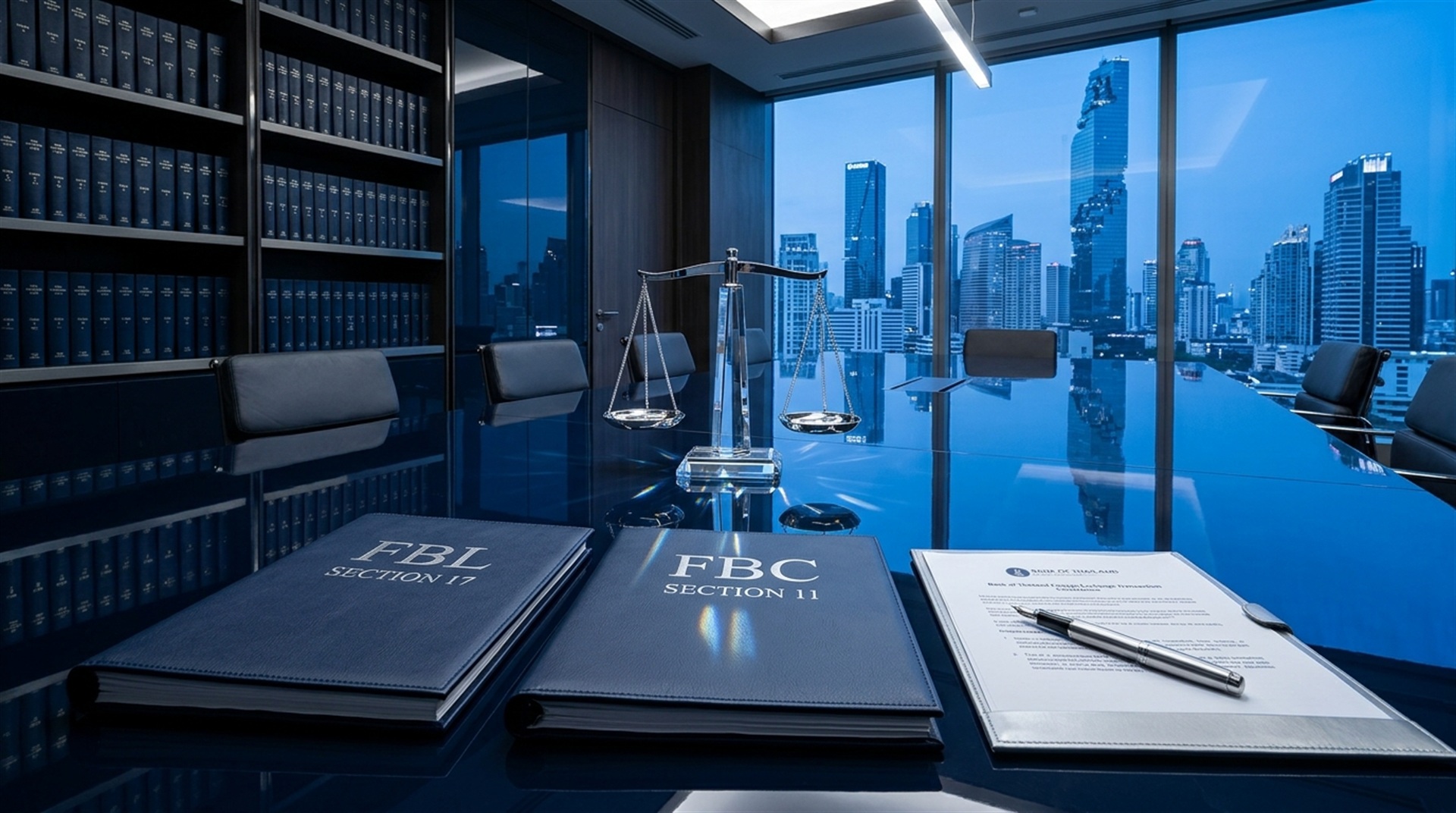
Executive Summary: The Non-Nominee Path to 100% Foreign Commercial Equity
For multinational corporations, foreign SMEs, and institutional investors establishing operations in Thailand, navigating the Foreign Business Act B.E. 2542 (1999) ('FBA') is the single most critical structural hurdle. Historically, ill-advised market entrants sought to bypass foreign ownership limitations by adopting informal 51% Thai nominee shareholding arrangements. In late 2026, amid synchronized inter-agency enforcement sweeps led by the Department of Business Development (DBD Order No. 2/2569), the Department of Special Investigation (DSI), and commercial bank compliance units, nominee arrangements present direct criminal exposure, asset freezing, and structural liquidation.
The legitimate, statutory alternative to nominee exposure is operating with 100% foreign equity through either a Foreign Business License (FBL) or a Foreign Business Certificate (FBC). While business executives frequently conflate these two instruments, they represent fundamentally distinct legal mechanisms with different statutory sources, approval authorities, procedural timelines, and compliance burdens.
>> Core Commercial Takeaway: An FBC is an administrative certification of an existing legal right granted through special treaties or statutory investment privileges (such as the Board of Investment or the US-Thai Treaty of Amity). Conversely, an FBL is a discretionary commercial license granted directly by the Ministry of Commerce's Foreign Business Committee under Section 17 of the FBA. Choosing the correct instrument dictates your timeline, capital expenditure, and operational freedom.
Strategic Key Takeaways for Corporate Directors in 2026
Zero-Nominee Legality: Both the FBL and FBC allow a corporate entity to be up to 100% foreign-owned and foreign-controlled, entirely eliminating the catastrophic civil and criminal liabilities established under FBA Sections 36 and 37.
FBC Administrative Entitlement: Companies promoted by the Board of Investment (BOI), registered under the Industrial Estate Authority of Thailand (IEAT), or qualifying under international bilateral treaties (such as the US-Thai Treaty of Amity) obtain an FBC through a streamlined administrative verification rather than a discretionary committee vote.
FBL Discretionary Scrutiny: For commercial activities in List 3 of the FBA (most notably Item 21 'Other Service Businesses') that lack treaty or BOI eligibility, foreign entities must obtain an FBL under Section 17. Approval requires proving proprietary technology transfer, substantial employment of Thai nationals, and demonstrable non-competition with nascent Thai enterprises.
Section 14 Capitalization Thresholds: Foreign entities operating restricted List 2 or List 3 businesses must maintain a minimum registered capital of at least THB 3,000,000 per distinct business activity (or 25% of the average estimated expenditure over three years, whichever is higher), supported by official Bank of Thailand Foreign Exchange Transaction (FET) records.
Debt-to-Equity Discipline: The Foreign Business Act strictly restricts the borrowing capacity of licensed foreign businesses to a maximum Debt-to-Equity (D/E) ratio of 7:1, prohibiting excessive shareholder loans or intercompany under-capitalization.
1. The Statutory Architecture of the Foreign Business Act B.E. 2542 (FBA)
Enacted to regulate foreign commercial participation while safeguarding domestic enterprise, the FBA establishes three operational lists of restricted commercial activities:
List 1 (Strictly Prohibited to Foreigners): Activities closed to foreign participation for national security, cultural preservation, or agricultural reasons (e.g., newspaper publishing, radio/television, rice farming, land trading, and extraction of Thai medicinal herbs). No license or exemption can be granted under any circumstance.
List 2 (National Security, Natural Resources, and Domestic Culture): Businesses concerning national security, arts, crafts, traditional folk handicrafts, or domestic natural resources and environment. Foreign participation is restricted unless authorized by the Minister of Commerce with Cabinet approval (or under specific international treaties), requiring at least 40% Thai shareholding and Thai director representation.
List 3 (Activities in which Thai Nationals are Not Ready to Compete): The primary arena for international business in Thailand. Covers 21 specific business categories, including accounting, legal advisory, architecture, engineering, construction, brokerage, retail, wholesale, and most critically, List 3 Item 21: 'Other Service Businesses'.
List 3 Item 21 serves as Thailand's statutory 'catch-all' provision. Under prevailing jurisprudence and Ministry of Commerce regulatory guidance, virtually any commercial service provided for consideration—from software development and management consulting to technical advisory and marketing coordination—is legally classified as an 'Other Service Business' unless explicitly carved out by Ministerial Regulation.
2. Comparative Legal Analysis: Foreign Business License (FBL) vs. Foreign Business Certificate (FBC)
Understanding whether your corporate vehicle requires an FBL or an FBC is the central structural decision in Thai corporate market entry. The following matrix delineates their core statutory differences:
Statutory Basis: An FBL is governed by FBA Section 17 (discretionary ministerial license). An FBC is governed by FBA Sections 11 and 12 (administrative certification of pre-existing treaty or statutory rights).
Issuing Authority: FBL applications are adjudicated by the Foreign Business Commission (a committee of ministerial representatives chaired by the Permanent Secretary of Commerce) and approved by the Director-General of the DBD. FBC applications are processed directly by the Foreign Business Administration Division of the DBD upon receipt of prerequisite certificates.
Prerequisite Requirement: An FBL requires no prerequisite government promotion, relying solely on corporate merit and economic justification. An FBC strictly requires an underlying prerequisite: an approved Board of Investment (BOI) Investment Promotion Certificate, an IEAT industrial license, or Treaty certification (such as from the US Commercial Service and Thai MOC under the Treaty of Amity).
Discretion Level: FBL review is entirely discretionary; the Foreign Business Commission evaluates macroeconomic impact, technology transfer, and domestic market competition. FBC issuance is mandatory/ministerial; if the prerequisite promotion or treaty criteria are legitimately met, the Director-General must issue the certificate within 30 days.
Processing Timeline: FBL applications require a statutory review period of 60 days following formal dossier acceptance (often extending to 90–120 days including preparatory pre-screening). FBC applications are completed within 30 days from the submission of the qualifying prerequisite promotion.
Technology Transfer Mandate: FBL holders are legally bound to execute a formalized, multi-year Technology Transfer Plan for Thai employees. FBC holders under BOI or Treaty of Amity are generally exempt from this separate MOC technology transfer requirement.
3. The Foreign Business License (FBL) Section 17 Application Roadmap
For multinational corporations establishing service, consulting, engineering, or regional management entities that do not fit into BOI promotion categories, applying for an FBL under Section 17 is the sole legitimate pathway to maintain 100% foreign equity.
The Foreign Business Commission evaluates FBL applications across four statutory pillars codified in FBA Section 17:
National Economic Benefit & Technology Transfer: The applicant must demonstrate that the proposed business brings specialized technological knowledge, proprietary methodologies, or advanced intellectual property not widely possessed in the Thai labor market. The application dossier must include an itemized Technology Transfer Plan detailing curriculum modules, scheduled classroom and on-the-job training, designated Thai apprentice roles, and measurable competency milestones.
Domestic Competition & Market Substitution: The Commission scrutinizes whether foreign entry will unfairly displace or harm existing Thai domestic service providers. Applications succeed when they demonstrate either that domestic Thai firms lack the specialized capacity to serve the target market or that the foreign entity exclusively serves multinational corporate clients, affiliated subsidiaries, or cross-border export markets.
Employment Generation & Local Sourcing: The applicant must outline staffing projections, prioritizing the hiring, upskilling, and advancement of Thai national professionals across technical and executive tiers.
Financial Substance & Ratio Viability: The business plan must prove commercial viability, displaying audited capitalization, realistic 3-year revenue and expenditure forecasts, and adherence to statutory capitalization ratios.
4. Minimum Registered Capital & Section 14 Remittance Mechanics
Capitalization under the Foreign Business Act is subject to strict statutory rules that differ fundamentally from domestic Thai company incorporation:
The THB 3 Million Threshold: Under Section 14 and Ministerial Regulations, a foreign entity engaging in restricted List 2 or List 3 businesses must inject a minimum capital of THB 3,000,000 per licensed business activity. If the company operates three distinct restricted activities, its minimum registered capital must be THB 9,000,000.
The 25% Expenditure Rule: If 25% of the company's estimated average annual operating expenditures over its first three years exceeds THB 3,000,000, the statutory minimum capital is automatically elevated to that higher figure.
Staggered Remittance for Branch Offices: Foreign enterprises operating via an unregistered overseas branch office must remit their operational capital into Thailand on a mandatory schedule: at least 25% within the first 3 months of licensing, an additional 25% within the first year, and the remaining 50% within the third year.
BOT FET Form Documentation: All foreign capital injections must be remitted via international SWIFT transfer, denominated in foreign currency, and specifically tagged with the SWIFT reference 'Share Capital Investment' or 'Operating Capital for Foreign Business'. The remitting institution must secure an official Bank of Thailand Foreign Exchange Transaction (FET) form / Credit Advice to present to the DBD registrar.
The 7:1 Debt-to-Equity Ratio Cap: Under Section 14, total corporate borrowings (including commercial loans, parent company promissory notes, and intercompany debt) must not exceed 7 times the company's registered capital. Breaching this ratio exposes the foreign license to administrative revocation.
5. Real-World Corporate Structuring Scenarios
To contextualize these statutory pathways, examine how multinational enterprises structure operations in Bangkok:
Scenario A: Global Cybersecurity & Enterprise SaaS Provider
A European cloud security software enterprise sought to establish a Bangkok hub to service enterprise banks across ASEAN. While SaaS development qualified for BOI Category 5.8 (yielding an FBC and zero corporate income tax for 8 years), their local cybersecurity advisory and on-premise implementation services fell under List 3 Item 21. Rather than attempting an illegal nominee structure, the firm established a BOI-promoted software entity and secured an accompanying FBC for support services, securing 100% legal equity with full administrative blessing.
Scenario B: Cross-Border Industrial Engineering Consultancy
A Japanese engineering firm providing specialized seismic and geotechnical advisory for mass transit infrastructure did not qualify for BOI tax holidays due to lack of local manufacturing assets. Instead of taking on passive Thai shareholders, the firm applied directly for an FBL under Section 17. By committing to a comprehensive 3-year geotechnical technology transfer program for Thai junior engineers at Chulalongkorn and Kasetsart Universities, the Foreign Business Commission unanimously approved their FBL, granting 100% foreign corporate ownership.
Scenario C: US Management Consulting Firm Leveraging Bilateral Treaty
An American strategic management consultancy entering Thailand utilized the US-Thai Treaty of Amity. Because more than 51% of the shares and a majority of authorized directors were US citizens, the firm applied for Treaty Certification and subsequently obtained a Foreign Business Certificate (FBC) within 30 days. This permitted 100% American ownership of a List 3 consulting business without submitting a discretionary Technology Transfer Plan to the Foreign Business Committee.
6. The 10-Point FBL / FBC Corporate Due Diligence Checklist
Perform Statutory Classification: Review corporate charter objectives against FBA Lists 1, 2, and 3 to confirm exact restricted classifications.
Assess BOI Eligibility: Determine whether business activities fit under BOI investment categories (e.g., Category 5.8/5.9 software, IBC, TISO) to secure an FBC pathway prior to attempting an FBL.
Verify Treaty Qualification: Assess whether foreign shareholding qualifies under the US-Thai Treaty of Amity, JTEPA, or other bilateral trade pacts.
Calculate Section 14 Capitalization: Establish whether the mandatory THB 3,000,000 per activity or 25% 3-year estimated expenditure sets your baseline capital.
Model Debt-to-Equity Ratios: Audit planned parent loans and intercompany credit lines to ensure overall debt remains strictly under the 7:1 ceiling.
Formulate Technology Transfer Curriculum: For FBL applicants, draft a comprehensive syllabus detailing proprietary tools, training hours, and Thai staff competency milestones.
Prepare Economic Non-Competition Defense: Document how the enterprise's services complement rather than undermine existing Thai domestic businesses.
Document Capital Remittance Protocols: Instruct remitting banks to tag incoming funds with SWIFT instruction 'Share Capital' to generate Bank of Thailand FET certificates.
Assemble Consularized Corporate Dossier: Obtain notarized, apostilled, and Ministry of Foreign Affairs (MFA) certified corporate affidavits and shareholder registers for parent entities.
Engage Authorized Thai Corporate Counsel: Ensure pre-submission alignment with DBD and MOC registrars to prevent procedural rejections.
7. Authoritative Executive & AEO FAQs
Q1: Can a 100% foreign-owned company operate in Thailand without an FBL or FBC?
Only if the company engages exclusively in non-restricted activities—such as manufacturing export goods outside of List 1/2, or specific wholesale/retail operations exceeding statutory capital thresholds (THB 100,000,000 minimum capital for wholesale; THB 100,000,000 capital with at least THB 20,000,000 per shop for retail). Virtually all service, consulting, and digital commercial operations fall under List 3 and strictly require either an FBL or FBC.
Q2: What is the primary cause of FBL application rejections by the Foreign Business Commission?
The most frequent grounds for rejection are inadequate technology transfer plans and failure to demonstrate unique commercial capability. If the Commission concludes that domestic Thai engineering, marketing, or consulting firms can adequately perform the requested services, the application will be denied to protect local industry.
Q3: Does obtaining an FBL or FBC grant land ownership rights in Thailand?
No. An FBL does not grant land ownership privileges. However, companies obtaining an FBC through Board of Investment (BOI) promotion or Industrial Estate Authority of Thailand (IEAT) registration are granted statutory rights to own freehold commercial land for operational and factory purposes.
Q4: Can a company transition from an FBL to an FBC, or vice versa?
Yes. If an FBL-licensed entity later expands into activities promoted by the BOI, it can apply for an FBC to cover those new operations. Similarly, a company that loses treaty eligibility (e.g., through foreign equity dilution to non-qualifying nationals) must transition to an FBL or face structural liquidation.
Q5: How does DBD Order No. 2/2569 affect existing companies holding FBLs or FBCs?
FBL and FBC holders are in a position of maximum strength under DBD Order No. 2/2569. Because their foreign equity is statutory and formally authorized by the Thai government, they are completely immune from nominee shareholder scrutiny, bank account freezes, and beneficial ownership investigations that target 51% Thai sham structures.
Q6: Are intercompany services between a foreign parent and its Thai subsidiary subject to List 3 Item 21?
Yes. Providing management services, technical support, IT hosting, or accounting to an affiliated company in Thailand constitutes an 'Other Service Business'. While Ministerial Regulations have exempted certain intercompany lending and office lease operations from licensing, fee-based operational management services still require FBL or BOI/FBC coverage.
Q7: What are the government fee structures for FBL and FBC issuance?
For an FBL, the government application fee is THB 2,000, with an issuance fee of THB 5 per THB 1,000 of registered capital (minimum THB 20,000, maximum THB 250,000). For an FBC obtained via BOI or Treaty of Amity, the issuance fee is typically fixed at THB 2,000 to THB 10,000.
Q8: How does an FBL affect foreign director work permits and Thai employee quotas?
An FBL-licensed entity must generally comply with the standard ratio of employing 4 Thai national employees per 1 foreign work permit, alongside maintaining THB 2,000,000 to THB 3,000,000 in registered capital per foreign employee. However, under BOI-promoted FBCs or Long-Term Resident (LTR) visas, the 4:1 Thai employee quota is completely waived.
Professional Legal Counsel & Confidential Health Check
Navigating the Foreign Business Act requires nuanced legal precision, direct regulatory relationships, and proactive structuring. GENTLE LAW IBL specializes in cross-border foreign direct investment, BOI applications, Treaty of Amity registrations, and Section 17 Foreign Business License dossiers for multinational corporations and international entrepreneurs in Thailand.
For a confidential corporate health check or strategic FBL/FBC consultation, contact our Bangkok legal team:
Firm: GENTLE LAW International Business Law
Website: https://www.gentlelawibl.com/
Corporate Advisory: gentlelaw.lawfirm@gmail.com
Bangkok Direct Practice Line: +66 (0) 96 579 5345
Jurisdiction: Bangkok, Thailand & Cross-Border ASEAN
>> Mandatory Legal Disclaimer: This publication is provided for general educational and informational purposes only and does not constitute formal legal advice. No attorney-client relationship is created by accessing this guide. Corporate directors and investors must seek personalized legal counsel from licensed Thai attorneys before executing corporate restructuring, capital remittances, or regulatory licensing applications in Thailand.


